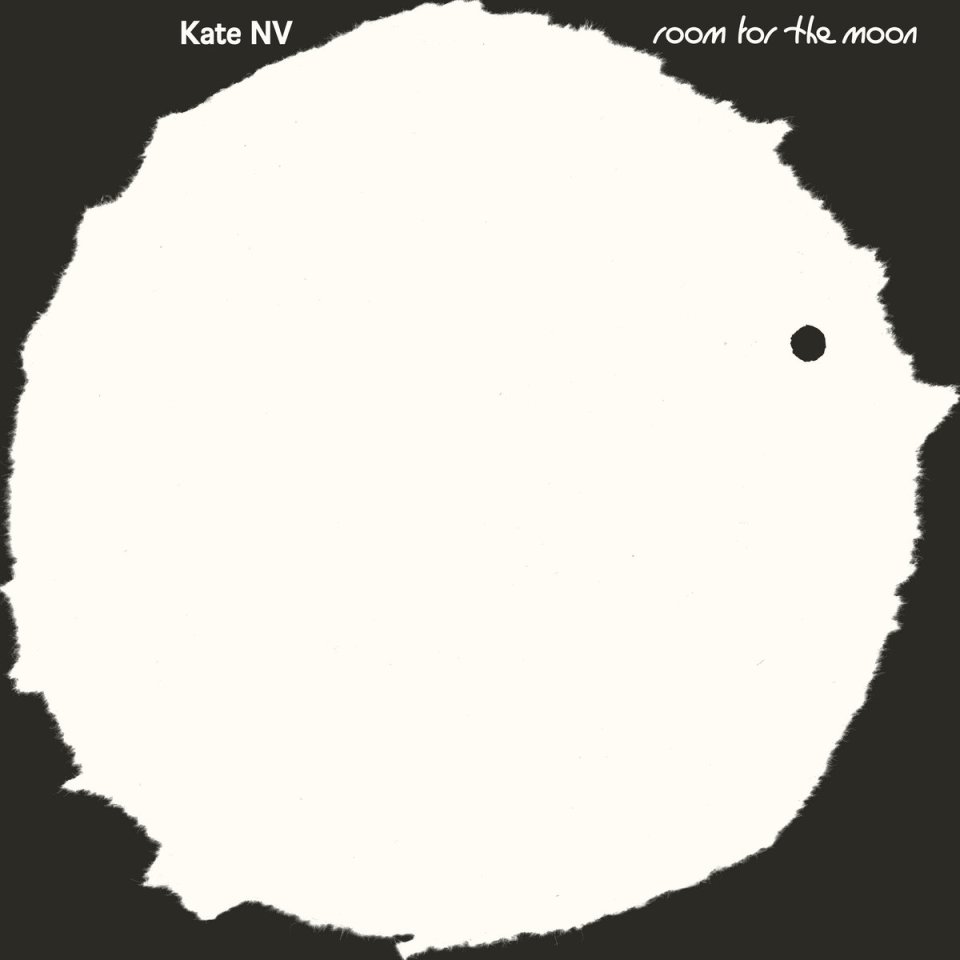
Russian musician Kate NV’s new album, Room for the Moon, expands on the minimalist synth pop from 2018’s для FOR. As with that album, analog synths garble, bleep, and thump, but this time around NV is much more polished. There is an immediacy to this album that was slightly missing from her previous efforts. The growth is noticeable, her voice is more confident, and her songwriting skills are sharp. As with all Kate NV albums, there remains a level of quirkiness certain to delight fans but risk a widespread embrace. It’s what sets her apart, however, and it is what will ultimately allow her to build an enduring legacy. Check it out if you like Japanese minimalism, Yellow Magic Orchestra, or analog synth pop in general.
This long lost gem of shoegaze has finally gotten the vinyl release it so much deserved by Light in the Attic. The music here is quintessential shoegaze. They open with a bang. Crystallize begins by throwing what feels like all of the guitar pedal effects one can muster at the listener. It’s a dizzying experience, and can be disarming upon first listen, but listeners who stick around are rewarded for their effort.
From there, they launch into “Just Alright,” a much more subdued piece that leans heavily on dreampop.
The real star here is “Bright.” Tokyo Shoegaze combines the squall of My Bloody Valentine, the harmonies of Lush, the vocals of Elizabeth Fraser, and some tight drumming to create a sound that is instantly recognizable, yet wholly their own.
Unfortunately, there aren’t many places you can listen to this album in full other than YouTube. If you like what you hear there, I highly recommend purchasing the new pressing from Light in the Attic and Graveface.
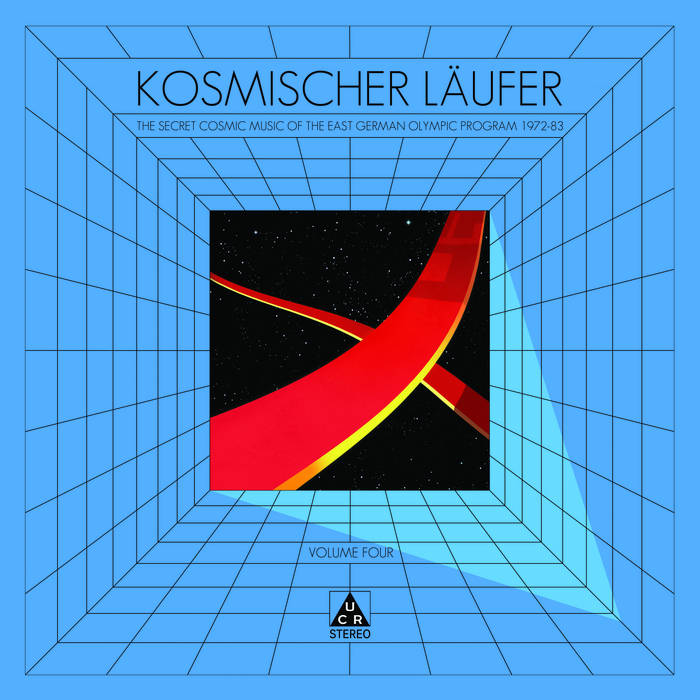
The fourth installment of the, supposedly, lost secret music of Martin Zeichnete, written to provide the East German olympic team music to train to, is once again a stellar example of motorik, electronic music in the vein of Tangerine Dream, NEU!, and Ashra. This time, along with the typical pieces we would expect from this project, side B contains a suite of music composed for a film meant to stimulate athletes. As always, it’s all a little too perfect to feel totally true, but regardless, the music is still well worth the visit, if not repeated listens.
With Flora, created under the moniker Polypores, Stephen James Buckley crafts beautiful ambient electronic, surrounded by field recordings of bubbling springs, rustling trees, and bird chirps. Yet there’s something other worldly about this music that plucks these familiar sounds from their associated surroundings, morphs them in front of us, and fashions them into an alien soundscape. This disassociation, and the creative employment of analog synths has been my go-to album for the past several days. Exceptional, mesmerizing stuff.
The most important thing you can work with is silence… I’ve always believed that one note is better than two, two notes are better than three, so it’s never hard to choose because you’re looking for very small fragments.
Mark Hollis – Vox, November 1991
First, let’s get this out of the way: I speak about very few albums as being perfect. From the beginning to the very last song, creating an album as good as The Colour of Spring is a one in a million accomplishment. This album is a masterpiece from every angle: the production, the musicianship, the vocals, the songcraft, the lyrics, the hooks, the flow of the album as a piece. Every time I put this on, everything feels right, and if I could only listen to 5 albums for the rest of my life, you’d be damn sure The Colour of Spring would be in there. So when I speak about this album, it is in no way objective, but it is sincere and with the utmost reverence.
Mark Hollis and Talk Talk went through a sea change after the synth pop successes of their earlier albums, The Party’s Over and It’s My Life. Colour marked a shift to a more tangible sound—the sound of real instruments, being played at the peak of musicianship, with a deft touch and with a discerning ear towards how separate pieces make up a whole.
In addition, we see Hollis and team begin their experimentation with negative space here—something they would go on to perfect with subsequent albums Spirit of Eden and Laughing Stock. The songs “April 5th” and “Chameleon Day” demonstrate this burgeoning interest most clearly on the album.
“April 5th” begins with gentle sequenced shakers and tambourine, and slowly takes shape with organ and Hollis’ soft voice. Throughout, droplets of instrumentation patter on top: a piano chord here, a sprinkling of acoustic guitar there, tender horns, subtle synth strings. It’s a pattern followed fairly closely on the rest of the album’s songs, but here Hollis and crew have stripped it down to bare bones, and in doing so draw attention to those moments in between the noise.
There’s a moment at the halfway point where the song hangs only on two notes from a keyboard for a whole 4 measures. It’s a wonderful demonstration of Hollis’ ability to build tension within songs by breaking them down to their barest moments. There are spaces in the song that remain unfilled by noise—gaps where the play between what is heard and what isn’t creates a dance of its own. It’s a realization of the idea that sometimes the most effective sound is no sound at all. This idea would go on to inform how Hollis shaped music for the rest of his career.
In addition to working in negative space, Talk Talk employ a diverse set of instrumentation in every one of these songs. In many cases, something will flit into the forefront, shape the song for a moment, then flit out never to be heard from again. It’s not the sheer amount of instrumentation that is of note here, however. It’s Hollis’ scrupulous employment of specific sounds and his ability to choose the right sound needed for each moment. Each choice feels as though it’s been given special consideration. And each choice shapes the songs in which they appear.
Take for instance, the wind instrument that chimes in at 2:03, in the left channel, in “Living in Another World.” This exact sound shows up perhaps 3 times on the entire album, none of which by haphazard choice.
Or consider the entirety of “I Don’t Believe in You,” in which organ drops in every so often, a heavily affected guitar bleats twice at the beginning of the song, a mellotron dances in quickly then vanishes, or a saxophone is added very low in the mix during the last lead-up. These pieces are sprinkled enough throughout until they become not only part of the whole, but the whole itself. It’s a master-class in song composition technique.
But nowhere does Hollis sacrifice pop sensibility for experimentation here. Unlike later albums, the songs here could be called pop music. And indeed, this album was Talk Talk’s greatest success, with “Life is What You Make It” charting in the top 20 and “Living in Another World” breaking into the top 40 in the UK.
“Life is What You Make It” is generally considered one of Hollis’ best pieces. Its inclusion after the confrontational and rebellious “I Don’t Believe in You” provides a counterpoint to that previous message. Hollis implores us to see life for what it is, to not rely on any other power, and to make it our own. It’s a striking song in not only its uplifting message, but also its incredibly catchy melodies. The chugging bass line, the mechanical and insistent drumbeat, the liquid synths, and the soaring guitar all coalesce to create the high mark of the album.
Hollis and Talk Talk would not reach these heights in popularity again, even through their following two albums are just as, if not more than, accomplished as The Colour of Spring. What they did help forge, however, was an appreciation for minimalist tendencies, and a focus on quality over quantity.
Much has been written about Hollis’ minimalist leanings and his reluctance to add to the discourse surrounding the music. In an interview for Vox, Hollis stated, “The most important thing you can work with is silence… I’ve always believed that one note is better than two, two notes are better than three, so it’s never hard to choose because you’re looking for very small fragments.” Those small fragments are all over Colour, and the effect is a meticulous masterstroke.
And so in the music, as in life, more is not necessarily better. When asked to explain his music in that same interview, Hollis retorted, “If you understand it, you do. If you don’t, nothing I say will make you understand it. The only thing I can do by talking about it is detract from it. I can’t add anything. Can I go home now, then?” And indeed, after he had made his mark, and his legacy was set, Hollis retired from making music, content in knowing what was written didn’t need adding to.
This band is relatively new to me, having first listened to them around 2013. But once I heard them, I immediately knew that they were something special. There’s so much to love here: the late John Lever’s precise and heavy drumming, the interwoven and at times delicate guitar stylings of Reg Smithies and Dave Fielding, or the solid and metronomic bass and voice of singer Mark Burgess. What’s recorded here is extremely tight, virtuosic, and while subsequent albums would prove this band contained heaps of talent, the debut album caught lightning in a bottle, and attained heights that wouldn’t quite be reached again.
The Chameleons in 1981
Album opener, “Don’t Fall,” sets the tempo with it’s heavy guitars and thunderous drums. This is music typically made by bands at the height of their skills, not those putting out their first album. Burgess describes a nightmarish room, evoking the confusion of Kafka’s main character in “The Trial.”
Alone in a room I’ve been in once before Shapes in the hall I’m running for the door I’m out on the edge but I’m not defeated yet I hear my name above everything else Mark! Mark! Above everything else Don’t fall.
Lever’s drums beat relentlessly while Fielding’s and Smithies’ guitars mesh to create a wall of distorted noise.
While “Don’t Fall” bursts unapologetically forward with its wailing guitars and drums, standout “Second Skin” opens with gentle synths, quickly giving way to chiming and repeating guitars and processed snare, granting the song with mostly tangible, traditional instrumentation a slight sensibility typical of electronic music.
All of this culminates during the interlude and change at around the 3 minute mark–which builds on reverberated, palm-muted guitars and thumping bass line–until the guitars break into a resplendent, sparkling dance, enveloping Burgess’s vocals and Lever’s drums in a wash of effects and emotion. It’s one of the most affecting moments of the album, and it comes relatively early on, jarring the listener to awareness and compelling them to pay attention. When Burgess sings:
But is this the stuff dreams are made of? If this is the stuff dreams are made of No wonder I feel like I’m floating on air
it doesn’t feel vacuous or limp. The words carry weight, and you feel their sincerity. This is someone with something to say. This is someone feeling something profound, and finding a way to express it in ways the listener can feel it as he does. It’s a moment musicians try to capture in earnest, and it’s done so beautifully here.
It’s remarkable that “Second Skin” was never a single, having been passed up for “Up the Down Escalator,” “As High as You Can Go,” and “A Person Isn’t Safe Anywhere These Days.” While each of these songs is good in their own right, they don’t carry the same weight, or showcase the band’s abilities quite as much as “Second Skin.”
Likewise, “Thursday’s Child” hits in ways those songs fail to. It is perhaps a modern take on the children’s nursery rhyme, “Monday’s Child.”
Monday’s child is fair of face Tuesday’s child is full of grace Wednesday’s child is full of woe Thursday’s child has far to go, Friday’s child is loving and giving, Saturday’s child works hard for a living, And the child that is born on the Sabbath day Is bonny and blithe, and good and gay.
Monday’s Child
Burgess sings of knowing the past, feeling its history, and of examining its faults. The song is about the onset of self-awareness, or rather the realization of this awareness is finally internalized. “I suppose/ years ago/ years ago/ I might have known.” It’s an assessment of maturity and the path taken to get there, but it’s also a cautionary tale about aging: “Please leave my mind intact/ as I slowly grow older.” Enlightenment, it seems, happens quietly. And then quickly, it fades. This fear, and others surrounding what it means to be human, is echoed throughout the album.
This is the type of album you can listen to a number of times and hear something new with each listen. It is rich, dense, and accomplished. The Chameleons only lasted from about 1982-1987, but in those few years put out 3 fantastic albums. Script of the Bridge is about as good a debut album as one is likely to see from any band, and the fact that it remains so obscure after garnering so much critical acclaim is mind-boggling. They never attained the same following as The Cure or Echo and the Bunnymen, but have nevertheless influenced many bands that followed. This one is likely to be in my own circulation for years and years to come.
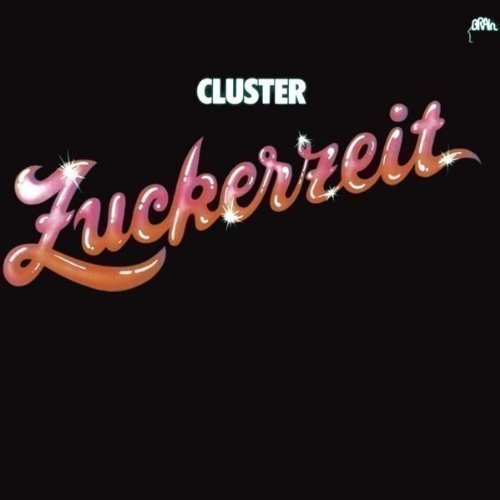
If you reach your hand into a box full of Cluster albums and select a random record, you’re bound to come out with something either pretty good to fantastic. Zuckerzeit is Cluster’s introduction to drum machines, albeit not the dance variety.
These drums shift and burble. They croak and whoosh. They are rudimentary in their design, and evoke an other-worldliness. There are bits of shakers here and there—a wooden block appears out of the murkiness in places. Through it all there is a dichotomy at work: dark, mumbling keys vs. bright, sparkly synths. It can feel at times as though you’re listening to this music underwater, or while traveling at the speed of sound.
This could be all dismissed as symptomatic of the year in which this was recorded (1974) and the infancy of the technology if Cluster weren’t so crafty. There’s a deliberateness behind this dichotomy. Up to this point, Cluster had recorded spacey, airy ambient music, and in the case of Cluster ’71, built on droning feedback and waves of static.
Take the song, “Rosa,” for example. Here we have shakers moving in and out of the mix while plucky synth leads dance above a deep and menacing bass line pooling below. The underbelly of the song, reverberations of unknown origin, slide in and out of our peripherals. It would feel a bit off the cuff if it wasn’t so intentional.
This soundscape is repeated in “Fotschi Tong,” to a bit of a higher degree. There, we hear Cluster push the drums slightly more to the forefront. They drift in and out of the mix with a bit more immediacy, wrapped in a slightly hazy reverb and heavy echo. Perhaps the most interesting thing about these songs, and “Fotschi Tong” in particular, is that although they feel repetitive in nature–the body of the song being composed by three notes–the appendages wiggle and writhe outside its core, creating new textures obscuring the inherent sameness.
Copyright Bureau B
Song to song, the album feels as a piece rather than separate entities coming together. The recording methods are incredibly consistent, even if the mood and feeling of each song is representative of itself. They all culminate on the album closer, “Heisse Lippen,” in fantastic manner.
It hits you with an immediacy as if announcing that everything proceeding was in preparation for this one song. It’s short, and leaves as abruptly as it enters. But what is left behind is an imprint on the listener’s ears and mind of something other. A foray into the new and burgeoning electronic field that would change the way we listen to music moving forward. And despite all that came after, the singularity of Zuckerzeit continues to amaze and inspire.
“This must be the ugliest piece of bread I’ve ever eaten.”
-YMO
And with that, begins Yellow Magic Orchestra’s fifth—and arguably best—album, Technodelic. As opposed to the object of their disgust in that opening line, the album sparkles and is an absolutely gorgeous set of electronic pop music from a group at the very height of its abilities, and whose intent appears to be to throw a bit of a wrench in their creative process.
As such, it’s a bit of a departure for the trio, dialing up and broadening the sonics while at the same time refining their approach in the studio. The comparisons to Kraftwerk had always been there, and were perhaps justified, but Technodelic put those comparisons to bed permanently by reaching beyond the motorik, blippy aesthetic of previous albums and embracing a sound suite wider in scope, but a method more succinct and precise.
It’s not that some of those previously similar elements didn’t find their way into the album. It is an electronic album, at any rate, in an era whose music in many ways emerged from the shadows cast by Kraftwerk. But there’s just so much more going on here than the minimalist electronic pop so closely associated with Kraftwerk’s back catalog. YMO sounds untethered by their previous touchstones.
The feeling one gets from the album with respect to their output to that point is deliberate, sharp, expansive, and eye-opening. It’s hard to imagine Kraftwerk, for all its brilliance and innovation, constructing something like “Seoul Music,” with its percussive vocal samples, looped melody, and chugging bassline—or the rolling piano and faux trumpets of “Stairs.”
The album notes YMO’s first use of the LMD-649 sampler. Unlike their previous albums, samples really take the forefront here. It gives the album a quality rooted in both realism and sequenced synths. Together with the live drums and Haruomi Hosono’s bass playing, the album feels on one hand more tangible, more present—and on the other, transcendental and difficult to pinpoint.
Synths are still clearly a part of YMO’s bag of tricks, however, but the live instrumentation (or sampling thereof) grounds the album in reality. Many of the songs here contain constant reminders of the real world, whether it’s through bits of sampled chants, stomps, or factory sounds. The lyrics tend to be focused around earthly topics and making sense of what’s in front of us; whether it be an ugly slice of bread (“Pure Jam”), a moth or key in a forest (“Key”), or a foreign culture (“Seoul Music”), time and again the theme that YMO returns to is our perception of the world around us and how realities vary from person to person.
Then there’s the Brian Eno-like “Gradated Grey,” its swooping bits of compressed and phased air and effects interweaving throughout, with what sounds like a processed train whistle acting to guide the song along. It’s the calm before the storm of “Key” kicks in, inundating the listener with a manic beat and sequenced synths underlined by Takahashi’s lilted vocals.
We see the culmination of these themes in the lyrics here: “What do you see? / I see a moth / What kind? / It looks like my lover / Whatcha gonna do? / I wanna chase it.” The speaker here has difficulty identifying what precisely he’s seeing and experiencing (“Somebody please, what’s wrong with me?”). He quickly becomes frightened, unable to both disseminate his reality and escape it using the key he’s found. “I’ve got a feeling something’s happening / It gives me a thrill but it’s also very frightening.”
In a way, what YMO seems to be saying here, is that sometimes it’s best to accept something for what it is. Allowing yourself to assign a value or definition to something based on the perception of the world around you can lead to confusion and frustration. Sometimes it’s best to experience something by letting it ride over you and be what it is. This is music steeped in both the history of traditional music and at play with unconventional and innovative forms. Perhaps the statement here that YMO wants us to leave with is “let it be what it is.” It’s music, and it’s damn good.
“When I played it back I thought, ‘This is OK actually, maybe I should release it.’ All the technical aspects of the recording were just right, too, not a single fault. I didn’t have to change anything. It was perfect.”
-Manuel Göttsching
Anyone who has ever picked up an instrument and spent time improvising, either by themselves or with additional musicians, will know of the feeling when a particular session comes together in a way as to feel complete—the feeling that the creative motor fires on all cylinders, and the physical execution rises to meet it. It’s what all musicians strive for: the convergence of skill and taste.
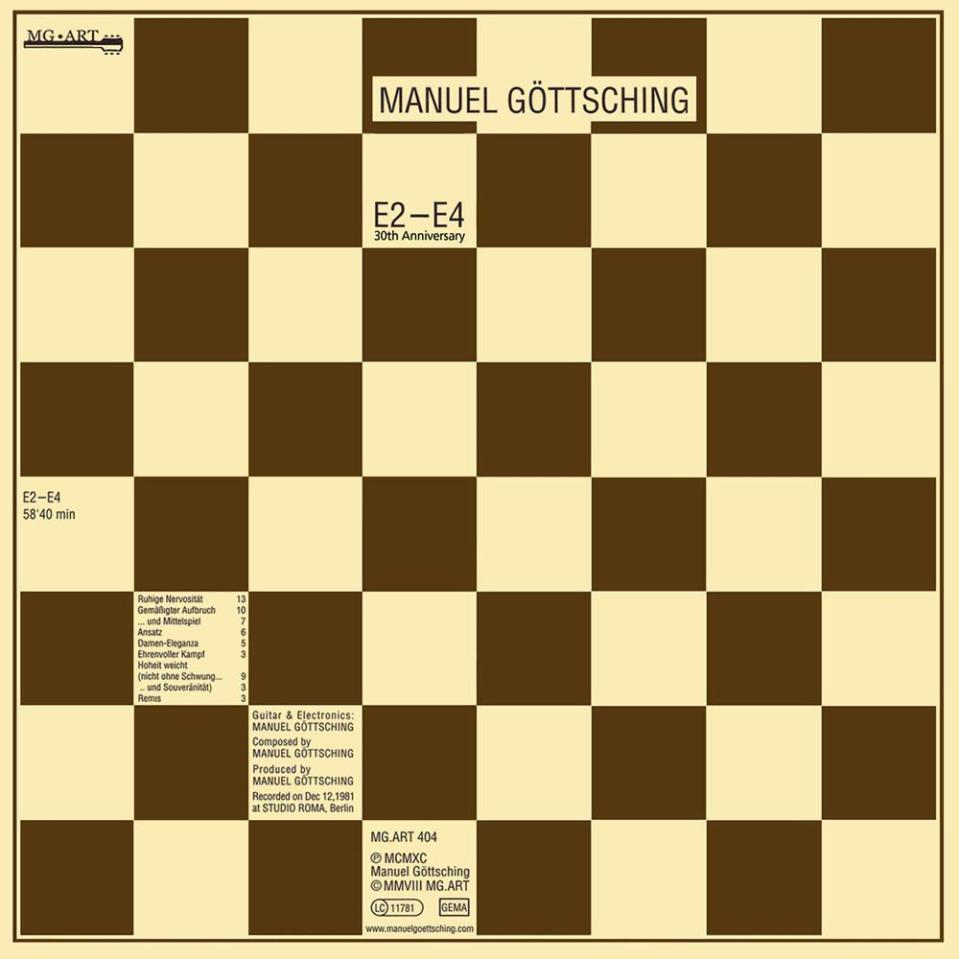
And hallelujah for the times the recorder was running! In the case of Manuel Göttsching’s E2-E4, not only was it running and set up to capture the session, but in a premonition-like stroke of luck, Göttsching proceeded as if he were to officially record a studio session.
Hindsight is 20/20 as they say, and how many times has a musician—at the end of a particularly sparkling session—exclaimed, “oh if we had just recorded that!”? To Göttsching’s surprise, and our good fortune, he did!
Prior to and during the time of the recording, Göttsching was captivated by compositions by prominent minimalists, such as Terry Riley and Steve Reich. His own work in Ashra (Ash Ra Temple) had grown progressively more electronic, incorporating loopers and synthesizers. He pushed Ashra, which by now was more a solo act than a group, from its early krautrock/progressive leanings into the forefront of electronic music.
Ever the guitarist, however, he began layering his guitar over the top of slowly morphing synths and gently-looped beats, and albums such as New Age of Earth, Blackouts, and Correlations would feature looped, treated guitar. This would continue to be his MO through much of the mid- to late-70s, leading up to the recording of E2-E4, when he began to experiment more with drum machines, sequencers, and synths.
The story, according to Göttsching, is that he wanted to record some music to listen to during a flight he was taking the next day. The result was a one take, hour-long piece whose foundation was a repeating synth riff over which he added some rolling electronic high hat and light, steady bass thumps. The centerpiece of the work—some lovely improvised guitar—enters the mix around the halfway point.
The album functions well as either background music or, arguably more so, when the listener is actively listening. It shines brightest through headphones and especially if said headphones are of higher quality and driven by decent audiophile equipment. That’s not to say you have to have higher-end equipment to enjoy the album. Its ability to grab the listener and take them in is mostly due to the structure of the piece itself, rather than the production quality.
Repetition is key here. It lends a stability to the piece that grounds it while at the same time allows it to transfix the listener. While it does on one hand somewhat point to the fact that this album was recorded spontaneously, it doesn’t come off as an unintended result due to the brevity of recording, or as the limitation of one man being at the helm. At many points, it keeps the piece from spiraling out from itself.
Take for example around the 47 minute mark. Göttsching’s guitar playing here has intensified, and begins to spread out. You can feel him pushing himself to let loose and fully explore how far he can take it within the confines of the song. It’s at this moment where his guitar comes as close to frenzied as it will within the piece. He feels like he’s getting ready to take off.
It is the foundation of the sequenced synths that keeps him in check. The interplay between this steady, structured base and the reaching, escaping guitar creates a beautifully strained and dichotomous pairing. It’s the climax of the album and it’s hard to resist bobbing your head along to it.
Göttsching has said that he didn’t immediately know what to do with this album after he had created it. He played it for Virgin managing director, Simon Draper, who liked it and referred Göttsching to Virgin Group founder, Richard Branson. He also liked it. Yet because of Göttsching’s reluctance to release it on Virgin to avoid it getting lost in a sea of mainstream releases now regularly coming through the label, it sat on the shelf until 1984.
He finally released it as E2-E4, a nod to both chess and R2-D2 (whose technical-sounding name he appreciated), on the smaller Inteam label. Its first run was 1,000 copies. The reception was modest, and it quickly faded into cult status.
It has maintained an influence, however, on electronic artists since its release. And while it’s certainly not widely known outside of the music industry and electronic music aficionados, it is undoubtedly considered a work of high achievement to those in the know. It is lightning in a bottle, or more precisely, on tape.
You can purchase E2-E4 at the official Ashra shop here.
Released in limited quantities in 1987, Elicoide is a beautiful example of minimalism in the tradition of Philip Glass, Steve Reich, John Cage, or Daniel Lentz, but with synths. It was recorded live in a single take by Nanni, contrabassist Paolo Grandi, Leonardo Croatto, and Marcela Pérez Silva.
The album is built around evolving repeating notes from a series of synths: SCI’s Prophet 5 & Sixtrak, Yamaha DX7 & TX7, and Roland JX8P. Nanni’s intention was to create a trance-like effect from the repetition and slow, subtle shift in changes with the notes themselves. Thus, the pieces immerse the active listener in an environment where tonalities and beats change on a seemingly microscopic level, but still progress the compositions themselves.
Nanni eventually gave up playing music in the 1990s and concentrated on his studies, which included biology and sociobiology. Recently, Elicoide has been repressed on Affordable Inner Space in 2017. Copies of which have since sold out.









 Desert Planet Music